

How Clore Leadership, Luton Arts, Revoluton Arts and Culture Trust are working together to build leadership, capacity and opportunity for Luton’s creative sector.
Leadership development can have an impact far beyond the individual.
For Natalie and Imrana, both of whom have participated in Clore Leadership programmes, the experience has influenced how they think about their roles, leadership and the development of Luton’s cultural sector. Their experiences now form part of a wider story about how investment in people, partnerships and infrastructure can help creativity thrive in Luton.
As part of Luton Arts, a two-year Arts Council-funded Place Partnership programme led by Luton Borough Council, in partnership with Luton Arts and Culture Strategy Group, the focus has increasingly been on understanding what the town’s creative sector needs to develop and what needs to change to create the conditions for creativity to flourish.
For Natalie and Imrana, their Clore experiences have contributed to that thinking in different ways.
Leadership that translates into practice
For Natalie, moving from a fundraising background into a role within Luton Arts has provided an opportunity to look at funding and cultural development from a different perspective.
I participated in the Global Majority Cultural Leaders programme, focused on restorative care and led by Clore Fellow Gaylene Gould, to strengthen the care-led approach I bring to my work at Luton Arts. One of the most valuable lessons was learning to check in with my body and recognise emotions such as frustration or defensiveness before reacting. This greater self-awareness has helped me regulate my responses, take pause, and reflect more thoughtfully in challenging situations.
Supporting artists and building partnerships is central to our work at Luton Arts, and there are times when we have to navigate difficult conversations, setbacks, or rejection. Being more self-aware has helped me build stronger relationships with stakeholders, approach challenges more constructively, and focus on what we can achieve collectively. I believe this has contributed to more meaningful partnerships and a stronger arts and culture sector, including collaborations such as the Luton Arts Support partnership between Clore, Culture Trust and Revoluton.
For Imrana, her experience of Clore has similarly informed how she approaches her role and works with artists, communities and partners.
“Early in my career, my mentor suggested I apply to Clore, but feelings of imposter syndrome hindered me from giving it any serious thought. In 2023 however, with encouragement from my manager, I felt confident about having the capacity to start thinking about my professional development, so I applied for the Emerging Leaders programme. It was a transformative experience. I recognised the invisible barriers many artists place on themselves and understood how important it would be in my role at Luton Arts to implement processes to address this.
As part of the Clore programme, there was a session led by Hiliary Carty in which she encouraged us to always ‘always count yourself in’. This was a pivotal learning point for me as I recognised previous moments where I had talked myself out of pursuing particular opportunities – sometimes due to feelings of unbelonging and, at other times, making assumptions that I was not the right person for the job. The idea of counting myself in shifted my perspective on how to approach new possibilities, and I realised how powerful this change in mindset could be to the artists I would be supporting through the Luton Create Fund.
The intentionality of removing barriers and encouraging a strong self-belief in artists became the foundation of my role as Project Commissioner. We introduced different pathways for people to apply and offered bespoke support to discuss ideas. We received an unprecedented number of applications, which is testament to the way inclusivity was embedded into the programme as a direct result of our learning from Clore.”
What connects these experiences is that leadership development is not simply about developing individual skills. It can influence how people make decisions, build relationships, collaborate and create opportunities for others.
That is particularly important within place-based cultural work, where progress depends on people and organisations being able to work differently together.
From individual development to collective capacity
Luton Arts has been exploring how to strengthen the wider creative ecology in Luton, not simply through individual projects or funding, but by building stronger systems, partnerships, opportunities and support around local creatives.
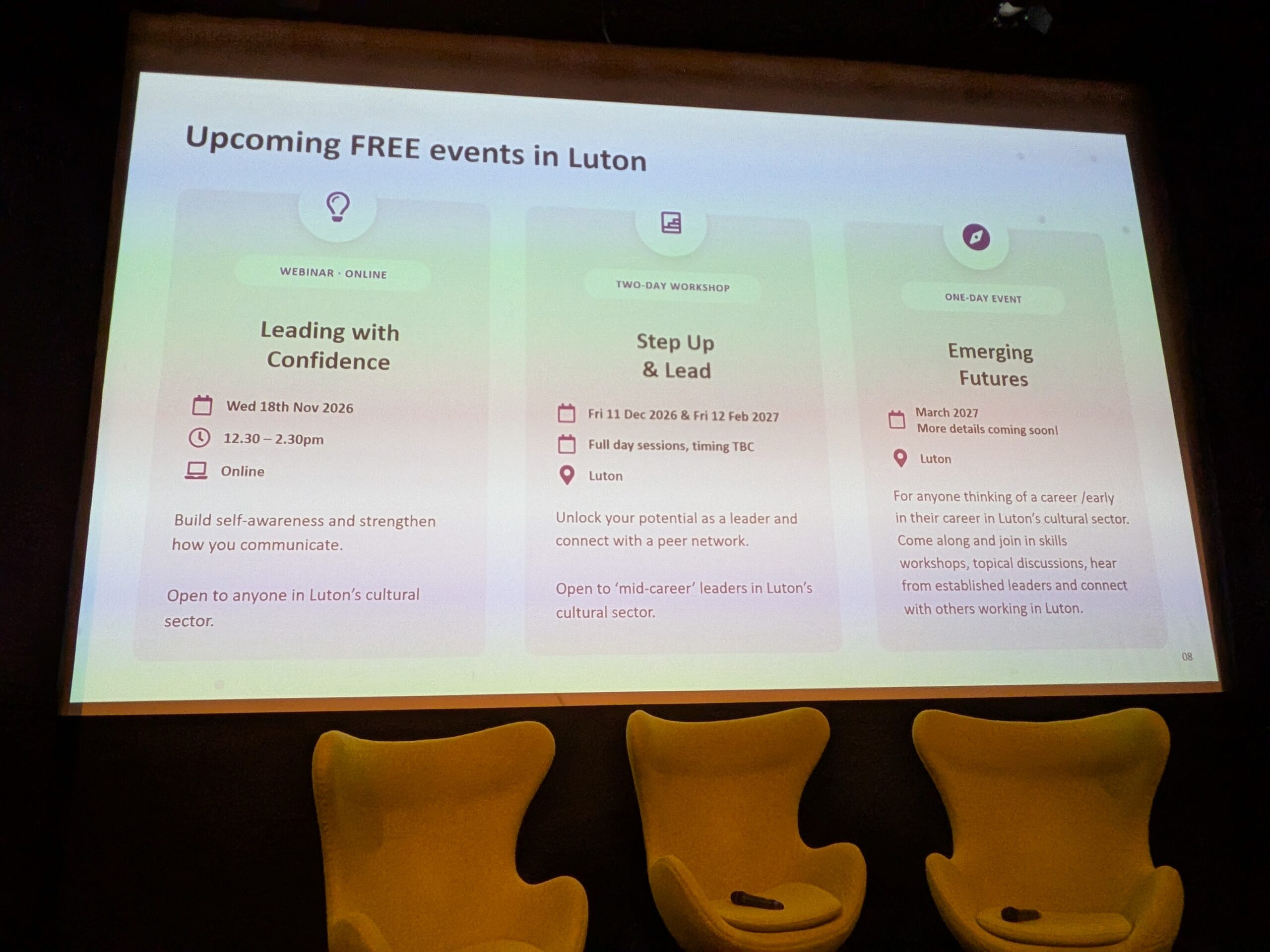
The new Luton Arts Support offer brings together three complementary partners:
- Revoluton Arts, providing one-to-one bespoke support for creatives.
- Culture Trust, providing a platform bringing together opportunities, resources and information.
- Clore Leadership, delivering an emerging leaders programme specifically for Luton.
Together, the partners provide different forms of support at different points in a creative’s development; from access to information and opportunities, to individual advice and leadership development.
The ambition is to strengthen the infrastructure around local creatives so that people are better connected to the support, knowledge, opportunities and relationships they need to develop.
Building the conditions for creativity to thrive
This approach reflects a wider learning from the Luton Arts programme: strengthening a creative sector requires more than delivering activity.
The programme has invested in understanding local needs, identifying barriers and developing more accessible approaches to funding and support. It has also explored how organisations and partners can work together more effectively to create a stronger creative ecosystem.
By investing in people who are working within and alongside the sector, the programme can help build capacity that extends beyond individual projects and contributes to longer-term change.
From individual leadership to a stronger creative ecosystem
The connection between leadership development and the wider creative sector is an important part of this work.
Developing individual leaders can strengthen organisations. Stronger organisations can build more effective partnerships. Stronger partnerships can create better opportunities and support for local creatives.
That creates a wider cycle of capacity-building.
For Imrana, one of the most significant areas of learning was active listening: “My understanding of ‘active listening’ became more refined through my leadership development with Clore. When working in roles that involve community engagement, it can be easy to fall into the trap of listening to people to achieve a specific outcome, but the art of listening attentively with other practitioners on the programme became a beautiful mechanism to get to know one another without any premeditated agendas.
Much of this learning fed into my conversations with partners, creatives and organisations through Luton Arts. It allowed me space to connect with people on a deeper level by learning about their hopes and dreams for using creativity as a means to spread joy. Ultimately, this fed into the Luton Create Fund commissioning process – both at its inception of encouraging people to dream big and apply to the fund, and then offering bespoke support to enable project delivery and professional development.”
For Luton Arts, this reflects a wider shift towards thinking about cultural development as an ecosystem rather than a collection of individual activities.
The programme has invested in understanding local needs, identifying barriers and developing more inclusive approaches to funding, support and partnership working.
Leadership development is one part of that picture, helping build the capacity of the people who are themselves contributing to the future of the sector.
For Natalie and Imrana, their Clore experiences therefore sit within a much wider journey; one that connects individual leadership development with organisational practice, partnership working and the future of Luton’s creative sector.
For Natalie, that learning has translated directly into how she works with artists: “I learned peer-to-peer coaching and asking open questions techniques through Clore and applied it to Luton Arts. In my one-to-one conversations with artists, I now always try and listen more open-heartedly, ask questions to support artists to unlock answers for themselves, instead of simply saying what I would do in their shoes (because I am not) or making assumptions from my own experiences. As a result, by listening deeply, we’ve been able to offer bespoke and effective support through the Luton Create Fund’s Wrap Around Support. I am really proud to have paired a local practitioner to be mentored by a West End Producer, strategically brokered relationships to enable one of our artists to put on an exhibition at Frasers Plus Luton.
The Luton Arts programme adopts the same approach of listening first, and by demonstrating the value of deep listening and bespoke one-to-one support, it’s now going to be offered long term through Revoluton Arts.”
Learning from the experience
Both have their own perspectives on what Clore has contributed to their work.
Natalie’s experience has also changed how she thinks about her own journey: “I would say absolutely go for it, and go in with an open-mind, curiosity, and do invest the time to be fully present during the sessions.
I was part of a small coaching group, where we were able to share challenges that we are facing and ask each other open questions, trusting the person bringing the challenge has the answer. It was very reassuring to know that I am not the only one non-linear journey and wearing several hats, and that through the group coaching sessions I could see we are good at celebrating and recognising the achievements of our peers but sometimes overlooking our own.
My Clore experiences encouraged me to celebrate myself and see my non-linear journey as a strength. I’ve leaned into this and drawn on my wide-ranging experiences to support Luton creatives in a bespoke way, from finding ways into commercial and west end producing, to balancing motherhood and creating work.
I’d like to think this played an instrumental role in enabling stakeholders to see the power of bespoke support, and I am proud to see we’ve now made this into a more longer term offer through Revoluton Arts.”
For Imrana, the experience has also brought a greater sense of confidence in what she can contribute: “Since being on the Clore programme, I have grown in confidence in the knowledge and skills I have to offer. My experience has enabled me to be more radical in my own practice as a creative producer and envision an even more dynamic future for the cultural sector through co-creation and partnership working.
For anyone not sure about applying, I would say if your intention is to learn more about your capacity of making a positive difference in the world, then go for it. It is normal to feel nervous when trying something new, but you will meet like-minded individuals and learn from experienced practitioners with a broad set of expertise. There will be some moments that challenge your thinking and mindset, and others that will reinforce your values, personally and professionally. Either way, you will have space to flourish with a positive-outlook on any future possibilities that come your way, and maybe even create your own pathways to success.”
These individual experiences matter because they help demonstrate why investment in leadership is relevant to place-based cultural development.
Developing confident, connected leaders can help organisations collaborate more effectively, challenge existing approaches and create better opportunities for the people and communities they serve.
What does this mean for the future of Luton?
The emerging partnership between Luton Arts, Clore Leadership, Revoluton Arts and Culture Trust creates an opportunity to build on this approach.
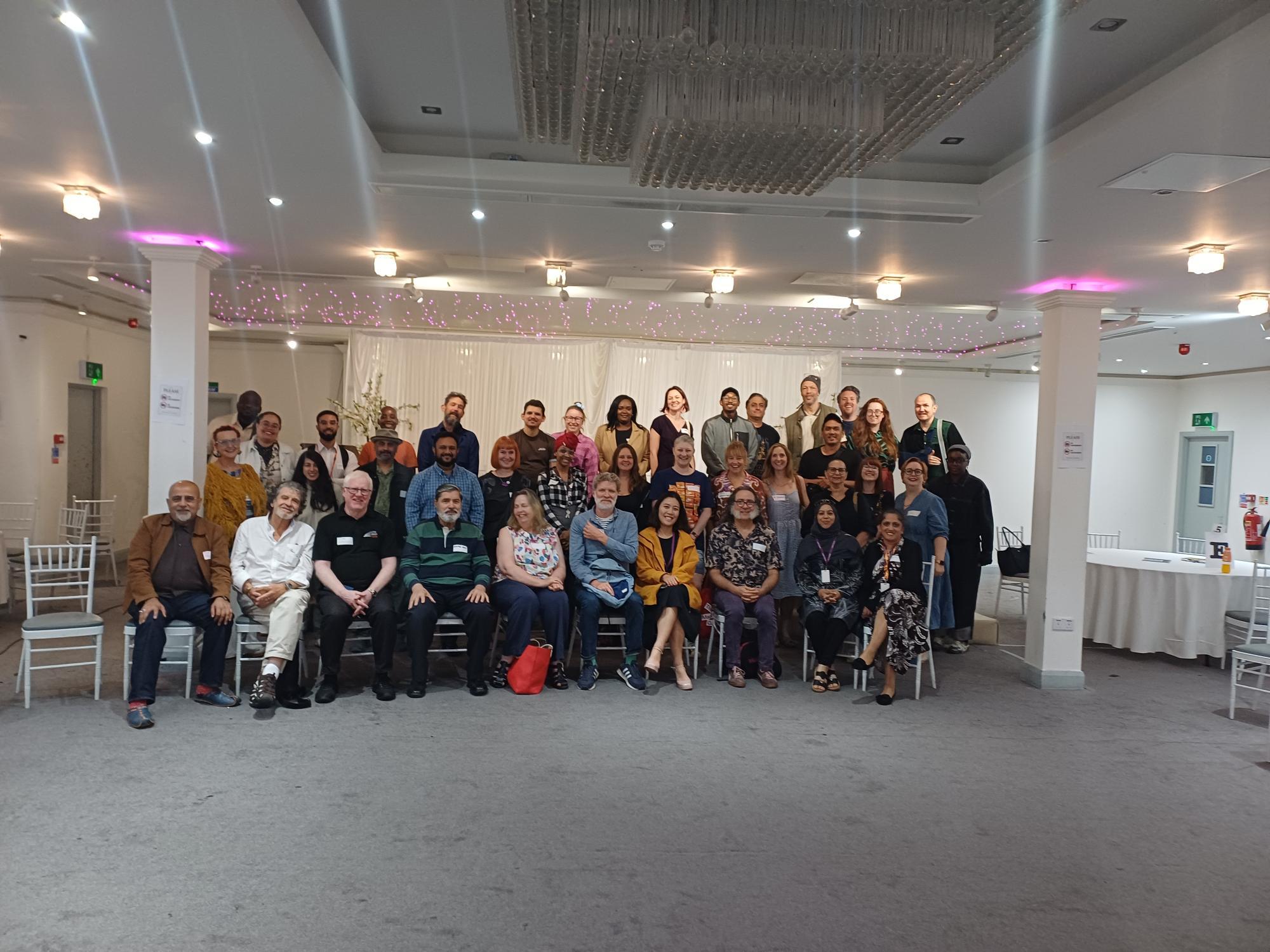
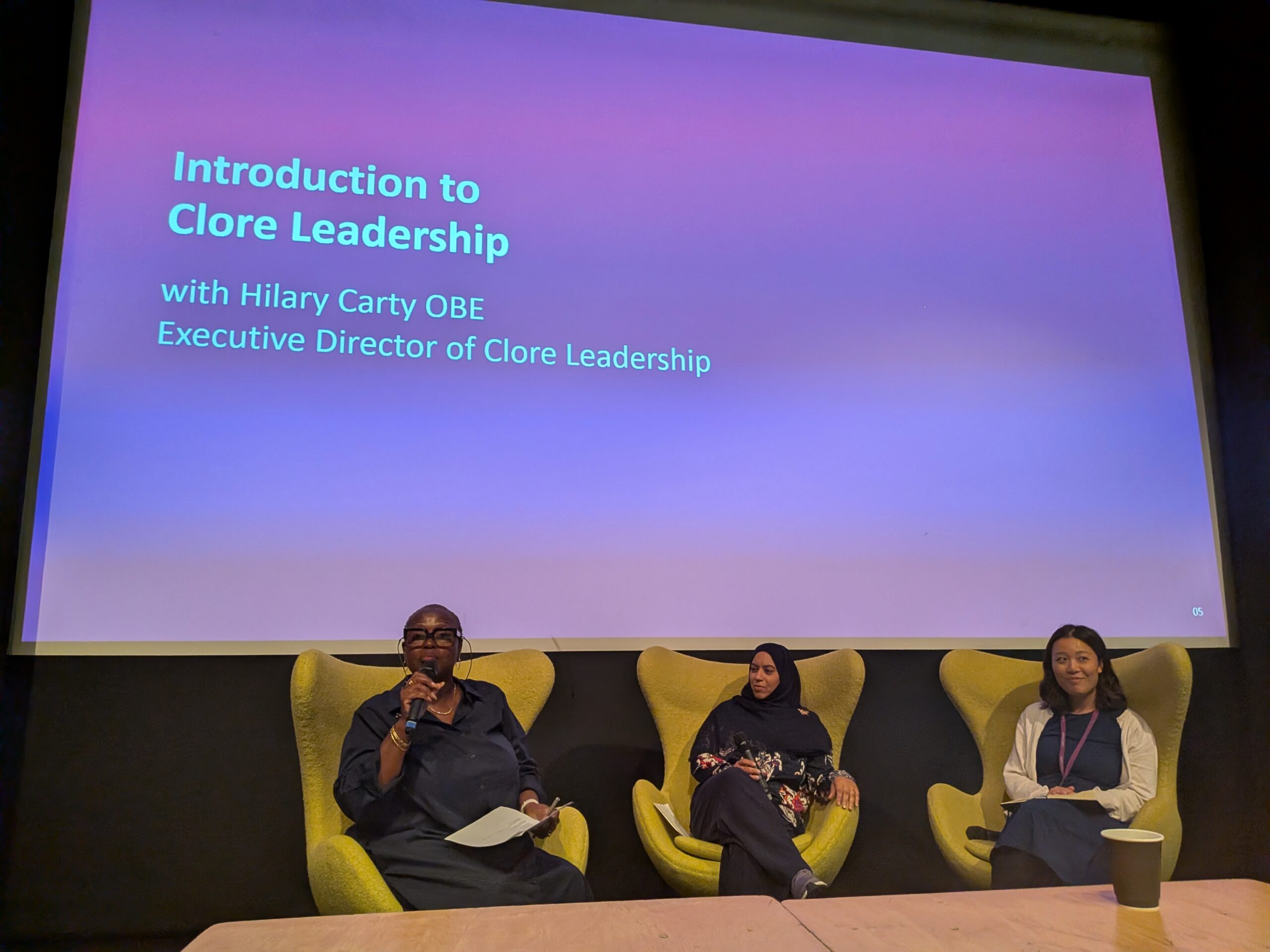
The September event, bringing Luton leaders together and featuring Hilary Carty in conversation with Clore alumni Natalie and Imrana, provides an opportunity to reflect on their journey and introduce the bespoke emerging leaders programme for Luton.
For Natalie, the response to the September event offered an encouraging glimpse of what this partnership could provide: “I was so pleased to see such a great turnout at the event, a willingness amongst attendees to exchange their journeys and thoughts, with people coming up to me and saying they are going to put themselves forward for the upcoming programme for Luton leaders. From my own experience having supported many practitioners leading excellent projects through the Luton Create Fund, we are certainly not short of innovative ideas and talent in the town. With the Clore Leadership programme holding space for emerging leaders to reflect and learn from each other as a group, I know we can work more collaboratively and maximise the collective impact of all of our work in the arts and culture sector, and I am very excited for what the future holds.”
Imrana saw a similar opportunity in the conversations taking place in the room: “The session highlighted the different ways people define ‘a leader’ – inspirational, empathetic and strategic were some of the words used. Attendees felt that inclusivity and collaboration were key to some of the biggest needs in leadership in Luton. The importance of organisations being visible and easy to approach to help lock into development opportunities also came up.
“The partners in this particular programme-we’re up for it. We want you to reach out, we want you to connect, to ask the questions, to share, to exchange. We want to make a difference.” [Hiliary Carty]
After the event, attendees shared that they felt inspired by the conversations and reflection activities. Having heard about our individual journeys, some felt encouraged about how Clore can help address challenges such as imposter syndrome but also instil a strong sense of self-belief. Many attendees were keen to take part in Clore’s upcoming offer with a view to applying for their national programmes in the near future. There was also a buzz about how Clore and the broader Luton Arts Support may be able to inject a renewed feeling of hunger and drive for positive change within the town.”
The aim is not simply to add another programme or initiative to Luton’s creative landscape. The significance of the partnership extends beyond the event itself. It represents an opportunity to bring specialist expertise together to strengthen the support available to local creatives, develop emerging leaders and build stronger connections across the creative sector.
The longer-term opportunity is bigger than one event. It is about continuing to build the people, partnerships and infrastructure that enable local creativity to develop and thrive.
Natalie and Imrana’s Clore experiences offer two individual examples of how leadership development can influence people working within a place-based cultural programme.
For Natalie, ultimately, the value of Clore comes back to relationships: “The value of Clore is being able to connect in-depth with yourself and other people. As much as we need resources and finances, relationships are the key and foundation for any collaboration, and I’ve definitely developed much better relationships through the Clore programme.”
For Imrana, that sense of possibility is at the heart of the experience: “Taking part in Clore will transform you into an even better version of the leader you already are.”
For Luton Arts, that means looking beyond what can be delivered today and asking what needs to be strengthened for the future.
Luton does not lack creative talent or ambition. The opportunity is to strengthen the systems, relationships and support around that talent so that creativity can thrive for the long term.
The partnership between Luton Arts, Clore Leadership, Revoluton Arts and Culture Trust is one part of that wider ambition to invest in people, create connections, support the next generation of creative leaders in Luton and build the capacity of Luton’s creative sector for the future.